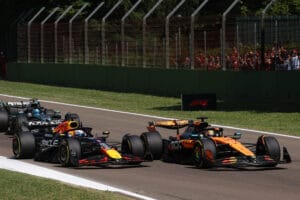


Tag Heuer, a partner from 1992 to 2003, is once again becoming the official timekeeper of Formula 1 for the next ten years. This provides the watchmaker with an opportunity to highlight its rich history with motor sports.
After a premium partnership with Paris 2024, LVMH marks its entry into Formula 1, whose 75th season resumes this Sunday with the Australian GP in Melbourne. Among the brands activated by the French luxury group (also including Louis Vuitton and Moët Hennessy), Tag Heuer replaces Rolex as the official timekeeper of the Championship. This is not surprising, as it is an integral part of the F1 landscape. “Motor sports are at the heart of the brand’s history,” states Nicholas Biebuyck, the heritage director of the watchmaker. “Being the official timekeeper of F1 is the best way to embody this.”
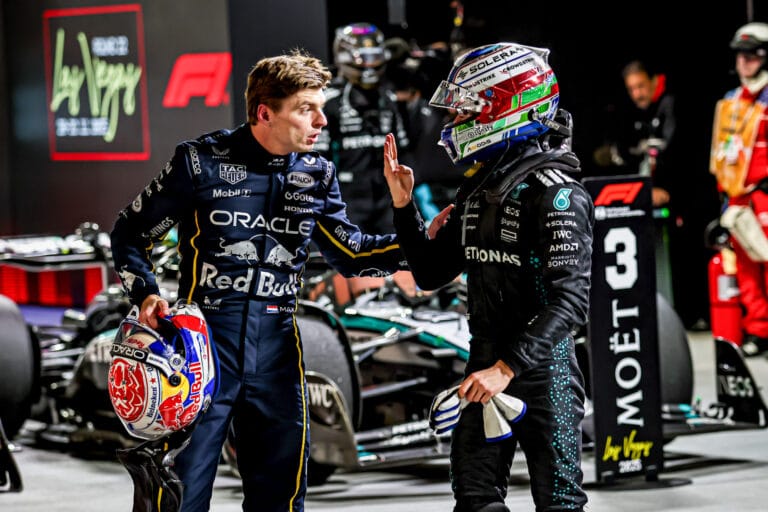
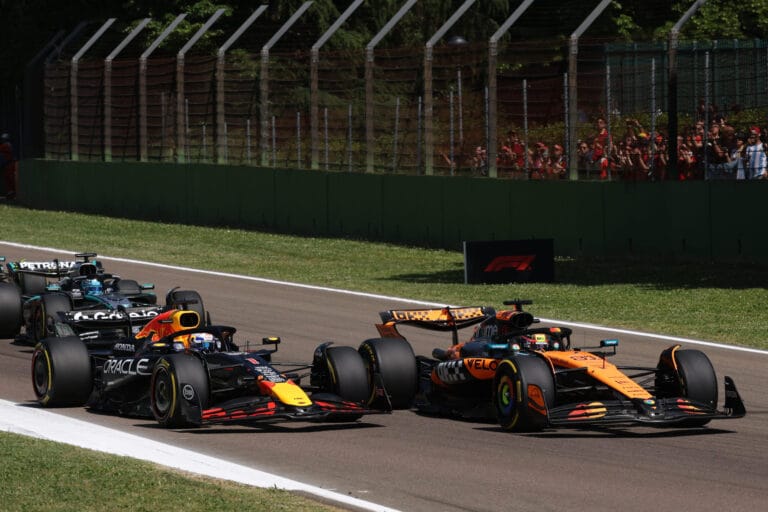
During the first half of the 20th century, it already equipped car dashboards with its chronographs. At the dawn of the sponsorship era, it was also the first to display its logo on an F1 car in 1969 and again the first to associate with a team, Ferrari, in 1971. Committed to the Scuderia until 1979, the brand spent thirty years (from 1986 to 2016) with McLaren before joining Max Verstappen‘s Red Bull team, with which it has renewed its partnership. These choices have been fruitful on a purely sporting level, with 15 World Drivers’ Championships, 11 Constructors’ titles, 239 Grand Prix wins, and 613 podiums to its credit.
Above all, the watchmaker has already been the official timekeeper of Formula 1, from 1992 to 2003. It therefore returns to this role, to which it adds the naming of the Monaco Grand Prix and a partnership with the F1 Academy, the 100% female single-seater championship.
Tag Heuer’s Historic Connection with F1
Tag Heuer’s resurgence offers an opportunity to breathe new life into the brand’s heritage linked to motor sports. The narrative is already well-crafted. “We are the most legitimate brand to talk about F1,” asserts Nicholas Biebuyck. “We have been with Ferrari, McLaren, and now Red Bull. We want to highlight this and show how we are historically linked to this sport, not just from a partnership perspective but also technologically. We have many stories to tell.”
One such story is that of the “Le Mans Centigraph,” a machine developed in Sarthe, capable of measuring times to the thousandth of a second. This device accompanied the developments of the Ferrari team on F1 circuits in the 1970s. In addition to this expertise, the company also aims to rediscover the history of the sport. “We still have many official timing sheets from the 1990s in our archives, as well as images, videos. We will highlight these resources.”
“But it’s not just about races or cars,” continues the heritage director. “We have more exciting stories to tell through the drivers and the teams. We are interested in personalities and we want to have the opportunity to talk about them. Ayrton Senna was one of our ambassadors and we are still associated with his foundation today. Lewis Hamilton, Michael Schumacher, Ayrton Senna, Alain Prost, Niki Lauda, Mika Häkkinen… Almost all the big names in Formula 1 have been linked to Tag Heuer at some point in their career.”
This is why there is a desire to maintain the collaboration with the Red Bull team. “If you are only partnered with one team, you cannot produce content on the track. If you are only associated with the franchise, it is difficult to tell the stories of the drivers. Having both makes the partnership more powerful.”
Brand Seeks New Consumers
More than twenty years after the end of its collaboration with Formula 1, the brand’s return is undoubtedly motivated by the new dimension the Championship has taken in motor sports. “In the 1990s, F1 was in a very different situation. Its audience was predominantly male, older, and very European,” explains Biebuyck. “Today, the market is very different, the audience is much larger, more international, and that’s perfect for us.”
Growing in popularity in recent years, Formula 1 amassed 1.6 billion viewers in its 2024 season and boasts 97 million fans on social media, according to its annual report published in February. Attendance at the 24 Grand Prix also increased by 9% in a year, reaching 6.5 million spectators on the circuits. This democratization is shaking up the composition of the discipline’s audience. Nearly one in three F1 spectators is now under 35 years old, and women now make up 42% of the overall audience.
By making its return as the official timekeeper, Tag Heuer is seeking new consumers. “In 1992, the company sought to become a globally recognized luxury watchmaker. The deal helped us, and Tag Heuer is now an established brand. Now, we want to use this partnership to reach a wider audience,” acknowledges Nicholas Biebuyck.
No major timing innovations are expected, as the solutions currently used are “derived from solutions developed in the 1990s. Timing in motor sports is very mature.”
“F1 reaches consumers with different profiles who consume information in very different ways. We therefore want to use as many channels and formats as possible: short videos, longer interview formats, podcasts, a book on the history of motor sports, etc. The mistake would be to tell the story in only one way with a single message.”