

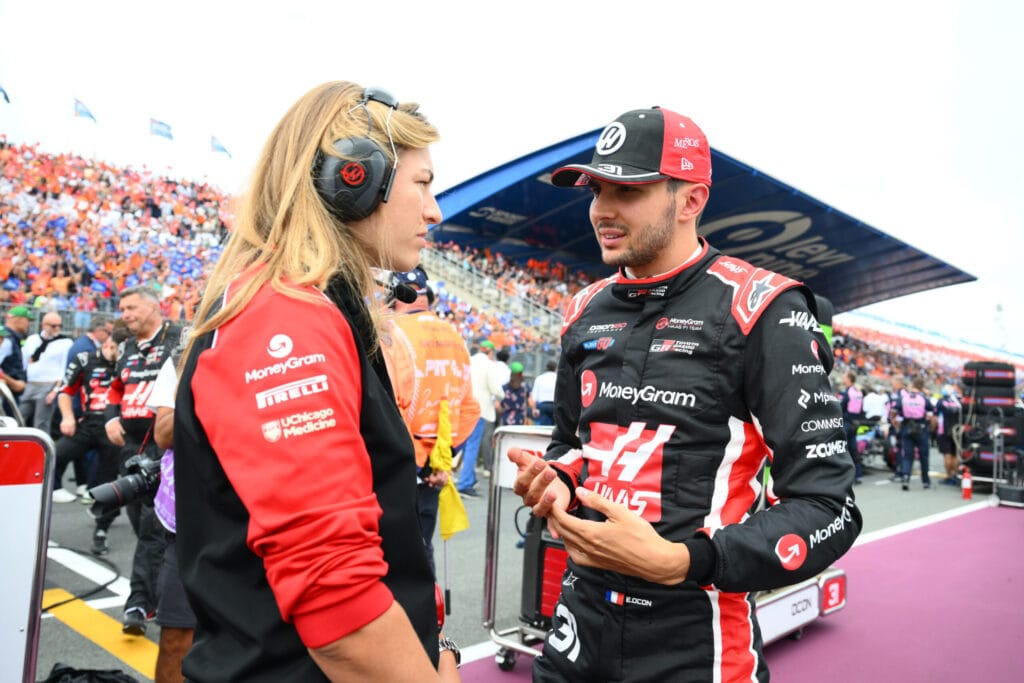
As the first female race engineer in Formula 1, Laura Müller (33) is living her dream at Haas. She discusses working in a male-dominated field, the role of Michael Schumacher, her connection with Esteban Ocon, and more. “I wanted to be a racer myself.”
It’s just another Sunday afternoon around the turn of the century. In the deep south of Germany, near the town of Konstanz on the Swiss border, the Müller family’s TV is tuned to RTL. Reporter Kai Ebel addresses the nation, talking about Michael Schumacher and his latest success. A little girl watches the screen, captivated. Her name is Laura. She dreams of making it to Formula 1, unaware of the unique role she will play a quarter of a century later.
– Before we talk about this year, let’s go back to the past: how did you realize your F1 dream?
“As a child, I was a huge fan of Michael Schumacher. It wasn’t just any Sunday, but every Sunday that I watched Formula 1. I even wanted to become a racer. That never seriously happened, as a child I had no idea that you had to start with karting. So, I ended up leading a ‘normal’ life. After high school, I didn’t really know what I wanted; so, I traveled to Australia. There, I realized, remembered, how much I loved cars. And I thought: if I can’t drive in Formula 1, then I’ll try to make it my job. So, I decided to study mechanical engineering and still get into this sport. I succeeded, through other racing classes, including DTM and WEC.”
– And now you’re the first full-time female race engineer in F1. How do you deal with all the attention that has brought? It could be an example for young girls.
“I noticed right away that there’s a lot of interest, but I’m not a big fan of interviews, social media, and the like. So, I tried to shield myself from all the attention. I didn’t read any of the news about it, let alone the reactions. I’m just doing my job, which I don’t think is that special. There are so many people who go to work every day just like me, so I don’t feel any different from others. Whether you’re a woman or a man shouldn’t matter.”
You are certainly an inspiration within the team.
“Together, we strive to get the most out of every weekend, performing at our maximum potential. This requires everyone, man or woman, to be on their toes. I play a crucial role in this. My primary responsibilities involve making decisions about the car.”
Of course, you don’t do this alone.
“That’s correct. I share and receive information from all departments, from aerodynamics experts, tire specialists, performance engineers, and so on. I then try to translate this information into a decision. This means that I don’t do productive work in the traditional sense. I make a lot of decisions, sometimes in a very short time. Of course, this is done in consultation with Esteban Ocon as the driver, and other responsible parties.”
How is your collaboration with Ocon so far?
“It’s going very well. Mainly because we are quite similar as individuals. He is actually very funny, more than some people might know or realize. Esteban can also be quite concerned, whereas I am more inclined to take some risks. When we inspect the track, I ride my bike and sometimes do crazy things. He then worries that I might hurt myself. We always have a good laugh about this.”
Did you have to adjust to each other?
“Not really, it wasn’t a huge adjustment. Esteban Ocon is experienced enough as a driver, but of course, he was joining a new team. For him, it was mainly about getting used to a different environment, for me, it was about adjusting to a new role. Of course, you need to get in sync as a driver and race engineer, especially in terms of communication. But I dare say it was much easier than I had anticipated. There were, and still are, occasional misunderstandings or minor mistakes. But these did not affect our performance. What helps is that we trust each other. He values what I say, takes it seriously, and vice versa. Whether it’s about the car’s setup or other things. His experience as a driver also helps me make better decisions. We always have an open dialogue, it’s not a matter of right or wrong.”
How much time do you spend with a driver during a Grand Prix as a race engineer?
“During the race weekend, it’s about ten to fifteen hours. We spend most of our time together on Thursday, which is one-on-one time where we prepare for the weekend and discuss all possible scenarios. We also work together before and after each session, he often sits next to me. We also always have contact during such a weekend, as a race engineer and driver you are always available for each other’s questions. So all in all, that’s quite a few hours you spend together when you add it all up.”
Does Ocon have certain preferences regarding the car’s setup or the amount of radio traffic?
“Like most drivers, Esteban wants a car that rotates as much as possible, but also a car that is stable when steering. Understeer is his biggest annoyance. In terms of radio traffic, it’s an advantage that he’s experienced, so he doesn’t need much input. In any case, you shouldn’t burden a driver with too many complicated things. As an engineer, you also don’t have unlimited time to convey the message. Being direct is then the best. During races, I try to give him as much information as possible, so he understands what we’re racing for, who against, and what the goal is. So he can take that into account in terms of tire management and driving style.”
You communicate in English, but do you also speak French?
(Laughs): “I lived in Belgium for a while, and therefore I know many French-speaking Belgians. I enjoy speaking a bit of French and understand quite a lot. That’s sometimes funny, because our performance engineer at Haas is also French. Esteban and he sometimes speak in that language, I can follow it quite well.”
Discussing Pre-Race Decisions: What Do Engineers and Drivers Talk About on the Grid in the Final Moments Before a Race?
“We often discuss the feelings that Esteban Ocon has on his way to the grid. Many people don’t realize that we make a lot of decisions on race day. We have all the information by Saturday evening, but the conditions on race day itself still determine a lot. For instance, the weather can impact the strategy. One of the last decisions I make before the start concerns the car’s aerodynamics. For example, what do we do with the front wing? We can still make some changes to it before the start.”
Reliance on Data vs Driver Input: With So Much Data Available Today, Do You Rely More on It or Does the Driver’s Input Prevail?
“The most important thing is that the data matches what the driver says and feels. Otherwise, you can’t make a good decision. It also depends on the moment; during a session itself, we have little time to thoroughly examine the data. So, we primarily rely on what a driver indicates. However, we can refer to the data to identify the cause of a problem, for instance.
Between sessions and in the evening, we have more time to review all the collected data. Often, additional details emerge that help us make better decisions. We never use data to verify what the driver has said. Instead, we use it to convince him to make a different setup decision than he might want.”
Pre-Race Rituals: Do You Have Any Specific Rituals Before a Race?
“I don’t have any special rituals or lucky charms, and I’m not superstitious at all. Esteban Ocon, on the other hand, is. So, I wouldn’t suddenly do something that could potentially fuel his superstitions. I just focus on my work.”
Split-Second Decisions: As a Race Engineer, Sometimes You Have to Make a Decision in a Split Second.
“Generally, I try to prepare most decisions in advance. This means that there are many ‘what if’ scenarios where we consider what we would do if problem X or Y arises, if the tires don’t hold up, and all sorts of things. If you’ve thought everything through, you can make decisions quickly. I always reason from the perspective that ‘a decision is always better than no decision’. This means that I don’t think about it for too long, but simply say: ‘Okay, we’re going to do it this way, and if it’s wrong, then it’s wrong’. But I can only do this because I have quite a bit of experience in motorsports. That helps.”
Memorable Moments from the Season
“There are so many. However, our memory tends to be short, as there’s almost a race every weekend. In any session, there are always things that stick with you about the car’s performance or Esteban Ocon’s. For instance, when you end up in the backfield during qualifying and as a team, as an engineer and driver, you still find a way to finish in the points… Those are the moments you live for in this sport, because we’ve managed to achieve something beautiful despite adversity.”
The Most Complex Aspect of Modern F1 Car Setup
“In my opinion, aerodynamics and tires are the most complex areas, as our energy management is handled by Ferrari and they have that well under control. In this case, I would say aerodynamics, because we can always manage tires in one way or another. However, aerodynamics is very inconsistent and a difficult aspect to control. When there are problems with it, it’s always hard to pinpoint the issue.”
Team Boss Komatsu Praises Laura Müller
Team boss Ayao Komatsu has high praise for Laura Müller. The Japanese, who has been at the helm of Haas F1 since 2024, lauded the German’s qualities, tenacity, and attitude from the moment she was appointed. “Laura is determined and works incredibly hard. When she sees a problem, she doesn’t take things for granted. Some people find an answer to their question and think: ‘Great, solved’. She knows that’s just the beginning and there are ten more questions to answer afterwards.”
According to Komatsu, this is exactly the mentality and approach that fits well with Esteban Ocon, making them a good duo. “Esteban is also a determined type. In that respect, I think their characters match well. They both feel the urge to perform.”
Müller is not the only woman at Haas F1, where more and more women are active in other engineering roles. However, Komatsu insists that her appointment was not driven by a pursuit of diversity. “It’s not about nationality or gender. What matters is the work: how well you fit into the team and how you can maximize performance. Laura is the best at that.”