
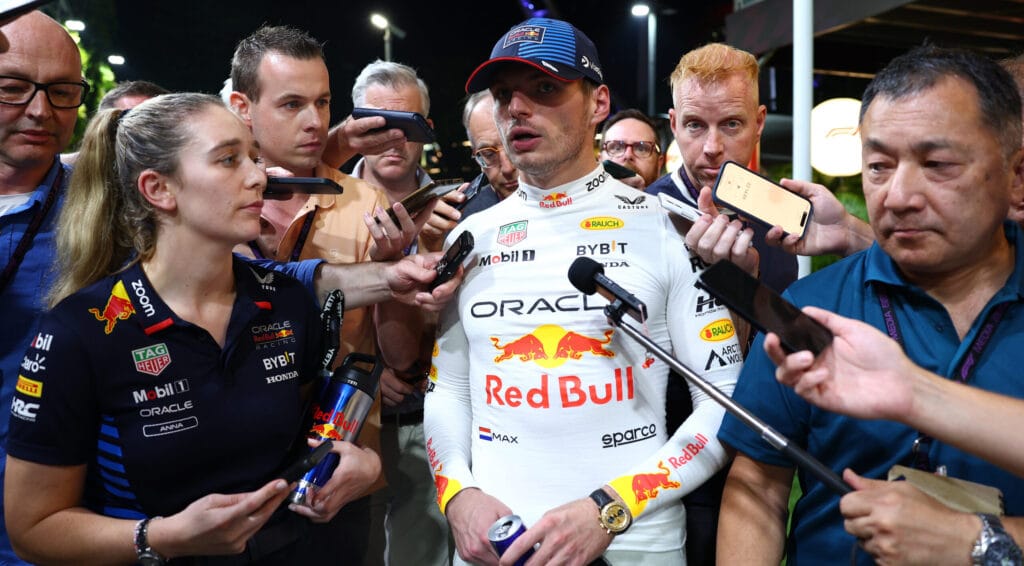
Many drivers these days seem to measure their words carefully. This is out of necessity, as those who speak out risk fines from the FIA, ridicule on social media, and the ever-watchful cameras of Drive to Survive. “Being fast and winning races is not enough to succeed in motorsport,” says communication expert Alexandra Schieren.
Alexandra Schieren has been working in the motorsport world for almost thirty years. For many years, she was a prominent figure in the Formula 1 paddock, first as a media delegate for the FIA and then as head of F1 communication for tyre supplier Pirelli. Nowadays, she runs her own sports communication agency bearing her name and guides young, talented drivers in media matters. Her most important advice to them? “Dare to be yourself.”
During her time with the FIA, Schieren developed into a crisis communication expert, as she notes with a touch of irony. She had to deal with various scandals. “Spy Gate, Lie Gate, Singapore Gate, Mosley Gate and many more challenging situations.”
Schieren, who also advises circuits and promoters on communication matters, has no ambition to return to the Formula 1 paddock. “Been there, done that,” she says. She derives most of her satisfaction from the variety of her current work in different racing classes. “It enriches me, as a person and as a professional, to immerse myself in different worlds.”
Schieren now follows Formula 1 more from the sidelines, occasionally marveling at certain decisions. Such as the initial decision to heavily penalize swearing. Last season, a first offense carried a fine of 40,000 euros, a repeat offense required a payment of 80,000 euros, and a third incident carried an even heavier sanction: 120,000 euros, a one-month suspension, and possible deduction of World Championship points.
‘Even drivers are adults’
“Everyone agrees that there should be a certain way in which drivers behave, especially in a popular class like Formula 1 with a wide reach, certainly among young people. But the drivers are adults,” Schieren begins.””There’s a big difference between insulting someone and saying something along the lines of ‘I fucked up my car’ or ‘My car is fucked’. With that, you’re not insulting anyone and it’s not aggressive. Moreover, as a sport, you don’t want robots behind the wheel, but to see emotions. That’s why people watch sports. As a viewer, you want to know what the drivers really think, really feel under that helmet. And if they feel muzzled and all start saying the same thing, they don’t need to give interviews anymore. In the past, drivers were fined if they got out of the car after a race and started fighting with each other. Logical. But a fine nowadays if someone says the car is ‘fucked’? Forgive me, but I don’t think that hurts anyone.”
“Moreover, Formula 1 is a live TV sport, but even live is relative. There’s always a slight delay, so plenty of opportunity to beep something out. And that happens. So what’s the problem here?”
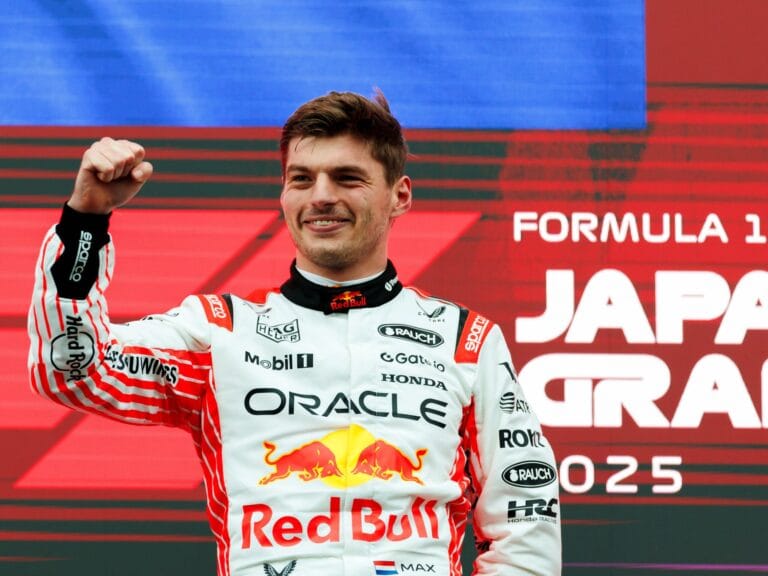
The community service that Max Verstappen received last year in Singapore for using the ‘F-word’, Alexandra Schieren, in her role as a PR expert in motorsport, calls disproportionate. According to her, the sport mainly shot itself in the foot because of all the negative publicity that followed. “Many fans reacted negatively, also because they didn’t understand.”
According to Schieren, it’s good that there are drivers who still dare to speak out and who are themselves under all circumstances. In other words, silence is silver, speech is gold. And not the other way around.
“I happened to provide training to a young driver yesterday, who indicated that Max is his example. Not only because of his driving style, but even more because of how outspoken he always is. And believe me, this is not the first time I hear something like this from young drivers. Certainly, the new generation must dare to remain themselves and continue to speak out, of course within certain limits.”
Self-regulation mechanism
– The result of the imposed penalty is that Max now keeps a lower profile in press conferences…
“And that’s a shame. Just like in any other sport, Formula 1 also has a self-regulation mechanism. If a driver goes too far, he loses sponsors, a seat, or feels the consequences in another way. As FIA, you have to look at the big picture and not do micromanagement.””The German-born, who resides in France, observes that drivers face a challenge in the complex power dynamics of Formula 1. “I know from experience how difficult it is, as drivers have to deal with so many different interests from teams, sponsors, media, etc. My advice to young drivers is to behave in the paddock as you would in everyday life and use your common sense. And if you are attacked, you can certainly defend yourself, but do it in a sensible way.”
Drivers and Social Media
“One driver is more outspoken than the other. Generally, you can say that the current generation of drivers is very aware of the significance of social media. In the past, when drivers said something, the media reported it. Nowadays, the impact is much greater due to social media. This changes the way the sport is perceived and how drivers communicate. They are now able to communicate directly with their fans, and the same goes for the teams. This offers opportunities, but at the same time, it also carries risks. The independent voice will always remain important for the credibility of a sport. Sometimes I feel that PR people think it’s their job to stop everything. And that’s wrong.”
Someone like Bernie Ecclestone always got annoyed at the sight of drivers walking through the paddock with a press man or woman by their side. He preferred men like James Hunt and Niki Lauda.
“I understand that, but those were different times. In the seventies, Formula 1 was more of a gentleman’s club. Bernie transformed it into a global sport with worldwide attention. Nowadays, so much money is involved in Formula 1, and sponsors demand a return on investment, which means that as a driver, for example, you can no longer mess up your own nest. You have to be aware of what you say and how you say it. And also of the consequences if you decide to take a risk by saying something unpleasant.”
Fear is a bad advisor in this regard. In her training, Schieren advises young drivers to learn from their experiences and mistakes. “Because that’s how you form your own personality.”
“Someone like Lewis Hamilton has done that too. When he started in Formula 1, he was very young and quiet. I worked for the FIA at the time. Gradually, we saw him change and grow in his role. And now he is one of the few outspoken drivers in the paddock, also because he can afford it and has created a certain aura around himself. It’s very difficult to get to that point, but it’s certainly possible.”
‘Being Fast is Not Enough’
“I train young drivers to understand the media. Of course, how to handle difficult questions, but also, or especially, to realize that you need each other. In fact, without good PR and without good interaction with the media, it’s hard to succeed in motorsport. In other words, being fast and winning races is not enough.”
The art, among other things, is to dare to be yourself, she continues. “You need to know who you are and what makes you unique, so that people remember you. I always say: ‘Show people who you are. Most drivers have talent and are determined to reach the top, but your personality is unique’. That last part is something a young driver needs to learn to use in a way that suits him or her. A good example is someone like Kimi Räikkönen. He was very popular with fans because he didn’t want to talk to the media. As an F1 driver, he was unpolished and authentic, and therefore also likable.”
Of the current generation of F1 drivers, everyone has had media training. “They all have the tools at their disposal, but some use them better than others,” says Schieren diplomatically.
In addition to Lewis Hamilton and Max Verstappen, she believes Charles Leclerc also excels at telling his story in a clear and likable way, even right after a race. “Charles is sometimes a bit too critical of himself, I think, but he does provide context, and that’s good. On the other hand, there are also drivers who only say yes or no and clearly show that they are not interested.”
But even for them, there is always a mitigating circumstance, she concludes. “Don’t underestimate it, it’s tough when you have to tell your story into a camera right after a race, knowing that millions of people are watching and scrutinizing every word. That being said, you have to be able to do it. It’s part of the job.”
As the saying goes: silence is silver, speech is gold.