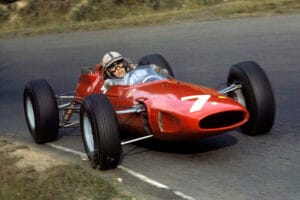


Eppie Wietzes from Assen emigrated to Canada at just thirteen with his family, became a race car driver, and even competed in two Formula 1 Grand Prix events. His son, Mike Jan Wietzes, was there to witness it all and reminisces, “Dad introduced me to Graham Hill, Colin Chapman, and Jim Clark. I didn’t really grasp how special those men were at the time.”
Post-World War II Drenthe. The Netherlands is rebuilding. The population has hit ten million, but scarcity still looms large. The government encourages “land relocation,” as emigration was then called, offering various retraining opportunities. Anyone interested in a future as a farmer could learn to milk cows in just six months. Canada is a favored destination, partly due to the Canadian soldiers who made a lasting impression during the liberation.
Jan and Klazina Wietzes from Assen, like many fellow countrymen, are eager for a Canadian adventure in those early post-war years. In 1950, they move to Toronto with their sons Egbert and Bert, where Jan opens a car garage. Egbert, just twelve, soon adopts the name Eppie.
The Wietzes garage quickly becomes the regional dealer for the Morris Minor, the small British car that would pave the way for the famous Mini. Racing becomes a passion, and by eighteen, Eppie hits the tracks. First with his father’s Morris, then with a Sunbeam Alpine. In 1958, Mike Jan Wietzes is born. “My dad was very young when I arrived, just twenty, but that never stopped him from racing,” Mike recalls from Canada. Now 67, Mike doesn’t speak Dutch, unlike his father. “Dad kept in touch with his parents, and I’d hear him speak Dutch on the phone with family, but at home, everyone spoke English.”
Injury on the Track
Eppie finds considerable success on the track. “In the early 60s, he connected with Comstock,” Mike shares. “That was a sort of Canadian factory team for Ford. They had a whole fleet of Shelby Mustangs and Cobras—real race cars. In 1965, Dad had an accident in one of those cars at Westwood Circuit in British Columbia, breaking his leg. That’s one of my earliest memories of my father’s racing career—him at home with his leg in a cast.”
A year later, Eppie is back, this time in a Ford GT40 from Comstock. Things are looking up! Comstock enters Wietzes into major races for the Can-Am championship and the World Sports Car Championship. Wietzes clinches several victories, including at Mont Tremblant and Westwood. But in 1967, Ford Canada pressures the team to halt their racing activities. “They wanted one last big bang that year. So, Comstock boss Chuck Rathgeb, who gave many Canadian talents a chance to race, rented the spare car from Team Lotus for the first Canadian Grand Prix at the Mosport circuit,” the insiders reveal.
At just nine years old, Mike Wietzes tags along with his dad to the circuits as much as possible. The Grand Prix isn’t just Wietzes’ first Formula 1 race; it’s his debut in a single-seater! There’s no time for a test run. The Ford GT is the fastest car Wietzes has ever driven, and the international press takes notice!
“Harvey Hudes, the owner of Mosport, wanted a Canadian driver, and although my dad had no Formula 1 experience, he was already a big name in Canadian motorsport back then,” Mike recalls. He’s just nine and can’t stay away from the Lotus pit all weekend. “By the way, that pit was just a big tent where the other two team cars were parked. Dad introduced me to Graham Hill, Colin Chapman, and Jim Clark. I didn’t really realize how special those guys were at the time. Chapman didn’t pay much attention to us; it was clear his focus was on Hill and Clark.”
Debut
This becomes evident when Clark spins during practice and bends his suspension against an earth bank. Suddenly, Wietzes, who has just settled into the third Lotus, has to hand over his car to the two-time world champion. Mike witnesses it all. “Dad barely got to drive in practice because Jim Clark had an accident, but I don’t think he worried much about it. A race car is a race car, he always said.”
Tragic Race Day for Eppie Wietzes: A Tale of Triumph and Disappointment
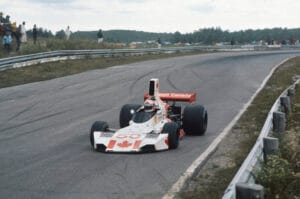
Eppie Wietzes, in 1974 in a Brabham BT42 Ford. Photo: Getty Images
On Saturday morning, Wietzes takes to the track for his first laps. “Carefully, of course, because it was raining,” he recalls. He qualifies in a disappointing seventeenth place out of nineteen drivers. Bringing up the rear is the little-known American club racer Tom Jones, who just a week earlier bought a Cooper Formula 2 car but is far too slow to even start the race.
The race itself turns into a major letdown. The relentless rain causes many cars to suffer electronic failures, and Wietzes finds himself stranded on the side of the track with a misfiring engine. A spectator lends him a towel, and Wietzes does his best to dry off the ignition. But an overzealous track marshal reports this to the race officials. By the time Wietzes is disqualified for outside assistance, he’s already out of the race for good.
A New Desire Ignited
Despite the setback, Wietzes’ brief foray into Formula cars ignites a new passion. “In Canada, Formula A was becoming very popular at that time, or Formula 5000 as it was known in most countries,” says his son Mike. “These were essentially Formula 1 cars with a 5-liter engine. Heavier and simpler, but almost just as fast. My father bought one and found immediate success.” Wietzes becomes the Canadian champion in 1969 and 1970, and he continues to thrive in the American championship. But the allure of Formula 1 remains strong…
Back to the Grand Prix
“In 1974, when I was sixteen, my father got another chance to race in a Grand Prix. He had much more experience this time, and the car seemed to be in good shape.” Wietzes steps into a Brabham BT42, rented by Team Canada. Though the Brabham is a year old, it looks immaculate in the colors of the Canadian flag.
But looks can be deceiving; the engine has issues. “We worked on it all weekend,” Mike shares. “I was already helping out in my father’s garage, so I knew a thing or two about engines, but we couldn’t get it sorted. During the race, the engine finally gave out.”
Racing Legacy Continues
Wietzes continues to find success in Formula 5000 until 1976. By then, son Mike is also racing. “I started with Formula Vee in 1979. My father helped me a lot, although he insisted I pay for everything myself. Apparently, my own racing activities reignited his passion, because a year later, we were together in the car driving 20 hours to the East Coast to pick up an old Corvette he had bought. We didn’t even know exactly what we were getting. But once home, he and some friends turned the car into a race-ready machine for the Trans-Am championship. He even won a race and became champion that season!”
Wietzes continues racing until the late 1980s, racking up wins. Meanwhile, Mike runs the auto business that his grandfather Jan started, and he still does today. In 2020, Eppie Wietzes passes away at the age of 82, marking the end of a significant connection to the Netherlands. Mike has never been to the Netherlands, but it’s on his bucket list. “Of course, we’ll go to Assen, where my father came from. Who knows, it might happen someday.”