




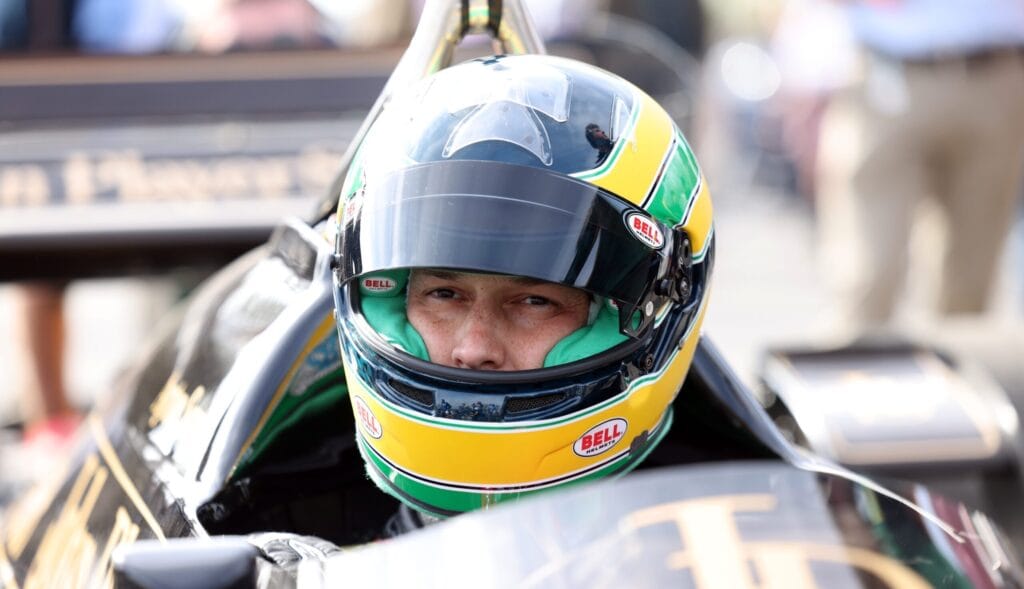
‘If you think I’m fast, you should see my nephew,’ Ayrton Senna once said about Bruno Senna. But at 42, one question remains: what if his family hadn’t banned him from racing after Imola ’94? About grandpa’s guilt, the heavy burden of a myth, and missed opportunities.
Accidents can happen to anyone, even the best drivers in the world. During the Tabac Classic GP at the TT Circuit in Assen, it’s not Bruno Senna behind the wheel of the iconic Lotus 97T, the car in which Ayrton Senna achieved his first Formula 1 victory in the rain-soaked Esteban Ocon, but his chief mechanic at Lotus, Chris Dinnage.
The reason? Bruno’s arm is broken and in a cast. A ‘stupid accident’, as he calls it. “I was riding a scooter down a hill, landed on a bump, and fell off.” Yet, the smile never leaves Bruno’s face on this sunny Sunday. Especially not when the Lotus 97T arrives at the start-finish line and a ceremony follows with grid girls, samba dancers, and applause.
Ayrton once said, ‘If you think I’m fast, you should see my nephew.’ Bruno laughs. “No pressure, right?” The Brazilian could never really live up to those sky-high expectations. His Formula 1 career was limited to three seasons, during which he mostly drove in the backfield. Helmut Marko once said ‘you will never be good enough for Formula 1’ and Ron Dennis considered him ‘too old to become a driver’. Did Ayrton get it wrong then? Well, Bruno’s career remains one full of what-ifs. Unfortunate, one might say.
‘Comparable Lap Times’
For young Bruno, a career in motorsport, with a three-time Formula 1 world champion as an uncle, seemed almost written in the stars. On weekends, he endlessly raced around the private karting track at his grandfather, Milton da Silva’s (Ayrton’s father) farm. “We drove all day, until the tires were worn down to the canvas or we got a flat tire,” Bruno recalls. “When I was seven or eight, I was already driving a two-stroke kart with a 125cc engine. That kart had a smaller inner seat (adapted to his height), the pedals were closer to the seat (so he could reach them), and there was extra weight on it (to meet the minimum weight). But despite that, I was driving comparable lap times to those of the professional drivers.””When Ayrton was in Brazil between F1 races, he took Bruno under his wing. “Ayrton was an incredibly good teacher. I remember him driving a 125cc kart and me in a cadet kart, a smaller version. He said, ‘Okay, let’s work on your racecraft.’ When he defended, he invariably blocked the inside. That frustrated me enormously. When I tried to overtake him on the outside, he pushed me straight onto the grass. He wasn’t so gentle,” Bruno laughs, “but his methods were very strong. Besides, he always had his hands on the controls and passed that knowledge on to me.”
Bruno Senna: ‘I think Ayrton would have been proud’
Sunday, May 1, 1994, is still vividly etched in the memory of many motorsport enthusiasts, even 31 years later. During the San Marino Grand Prix, Ayrton Senna’s Williams went straight on in the infamous Tamburello corner. He was tilted against the right side of the cockpit. A sad sight: the driver was dead on the spot. The Senna family decided that they had paid their contribution to motorsport with blood and forbade Bruno from pursuing a further career in the sport. “From one day to the next, racing became the worst thing for my family because it took him away from us,” Bruno sighs. “My grandfather no longer put me in the kart. He blamed himself for Ayrton’s death, because the agreement was that Ayrton would return to Brazil after the 1982 British F3 championship. I accepted his decision and as a 10-year-old, I couldn’t change much. But when I was 15 or 16 and saw some opponents winning championships, I thought: I can do this too, because I was faster than them.”
‘Didn’t want to go out’
At the age of 18, Bruno worked with his grandfather in one of their car dealerships and studied Business Administration at the university. “My mother realized that I wasn’t happy: I didn’t want to go out, I didn’t want to do much,” says Bruno. “She came to me and said, ‘You’re getting older. What do you want to do with your life?’ And I was like: you know mom, I would like to race again. She wasn’t angry, but she was surprised, because I hadn’t talked about it for eight years. She thought it would pass, but when she realized I was serious, she supported me enormously.”
Bruno’s Early Career and Near-Death Experience
Bruno’s career was still in its infancy when he narrowly escaped death during a British F3 race at Snetterton. Traveling at over 250 kilometers per hour, he collided with an opponent’s car that defended its position at the very last moment. His car spun around, hitting the top of the bridge on the circuit with its rear, before shattering on the asphalt. “There was no TV footage of the accident. I ran back to the pits immediately, hoping my mother wouldn’t see the car. But she was already there, saw the wreckage, and started crying. At the same time, she realized that the sport had become much safer than before. That alleviated some of her fear,” he recalls.
Family Resistance and Reconciliation
His grandfather initially strongly opposed his return to motorsport. “He didn’t speak to me for three years,” Bruno shares. “That was tough, especially since we had a close relationship. But,” Bruno continues, “in my second season in GP2, he saw that F1 was within reach. Slowly, he began to open up again, but it took a lot of time to mend our relationship. Fortunately, I know he was very proud of me. Whenever I achieved a good result, he would always tell his family members and employees.”
The Struggle of the Comeback
The comeback was a battle on multiple fronts for Bruno. “It was interesting,” he says somewhat sarcastically. “I had a short career, so I had to learn everything on the job, but from my very first race, I was already being compared to my uncle. All eyes were on me, and every mistake was publicly magnified. In that situation, you can only lose.”
Support from Gerhard Berger
At the time, Gerhard Berger, a former teammate of Ayrton and a good friend of the family, co-owned Toro Rosso. He came to Bruno’s aid. “He brought me to Europe and created opportunities for me to race,” Bruno begins. “His mentality was: I’ll push you hard, because if you don’t succeed quickly, there’s no point in even starting. In just four years, I was knocking on the door of F1, while my competitors had been racing for 12, 13, or even 15 years. It was mentally extremely tough, but he really made a difference by pulling me through.”
‘My First Victories’
In 2006, Bruno competed in the British F3 Championship. Less than a day before departing for the race weekend in Australia, he tested at Oulton Park. With his sweaty racing suit and seat – there was no time to make a new one – he boarded a plane to Melbourne from London. Due to a delay, he rushed directly, with all his luggage, to the Albert Park Street Circuit. In the paddock, he quickly changed into his racing suit, his seat was hastily mounted in the car, and he drove straight into the free practice. The result: Bruno won three out of the four races, the name Senna was once again significant. “They were my first victories,” he recalls. “Upon returning to the UK, I also won the first three races. At that moment, I got a huge boost of confidence, but it was only my second year in motorsport and it remained a mystery to me why I was sometimes so fast and sometimes couldn’t reach the same level.”
Two years later, an even bigger milestone followed: Bruno won the GP2 race in Monaco. ‘King of Monaco’ Ayrton holds the record there with six victories, took pole position in 1988 with a stunning lead of 1.427 seconds over teammate Alain Prost, and was on his way to lap the entire field until he crashed. The concept of flow state was personified that day, making Bruno’s victory all the more special. “It is the most beautiful memory from my racing career. Grand Prix podium ceremonies are so generic, but Monaco is different. Even the police in the streets of Monaco congratulated me.”
That same year, Bruno first experienced an F1 car during a test for Honda at the Barcelona circuit. The team offered him a contract, but before he could properly read it, Honda withdrew from F1. Ross Brawn took over the team and renamed it Brawn GP. “We urged Brawn and Nick Fry for a seat, but they thought it was too risky to go with a driver without experience,” Bruno explains. The rest is history: Jenson Button clinched the world title and the fairy-tale team quickly disappeared from the scene. “I believe my F1 career would have looked very different if I had stepped into a championship car. But well, it is what it is.”
Senna Prost 2.0
After a ‘gap year’ in the Le Mans Series, Bruno made his F1 debut in 2010 with the struggling Hispania Racing Team (HRT). The team languished at the bottom all season and scored no points. Bruno retired nine times, usually through no fault of his own, and his best result was a fourteenth place. “It would have been better not to start my F1 career with that team, even if that meant I wouldn’t have raced at all in 2010,” he concludes. “The car was not competitive and very unpredictable. It was a terrible and mentally draining year, which had a lasting negative impact on me during the rest of my F1 career.”
Bruno Senna’s Journey in Formula 1
In 2011, Bruno Senna had to settle for a role as a test and reserve driver at Renault. However, midway through the season, a new opportunity arose when Nick Heidfeld was dismissed. “The car was significantly more competitive in the first half of the season,” he says. “But I seized my chance by scoring points, in a car that was not consistently capable of doing so.”
Challenges with Tyres
His performance was enough to convince Williams, the team where his uncle tragically lost his life. Bruno discussed the loaded offer with his family and made it clear that he could not pass up this ‘first chance at a full Formula 1 experience’. “They understood and supported me. The circle was complete: it took away some of the negative feeling attached to the past.” Yet, that season also had its challenges: in 15 of the first 18 free practice sessions, he had to give up his seat to Valtteri Bottas, thereby missing valuable data and two sets of tyres per weekend. “In essence, I was still a rookie. It was Pirelli’s second year in the sport and the tyres were incredibly difficult to understand.”
End of Bruno’s F1 Career
Bruno’s F1 career eventually fizzled out. “It wasn’t the end of the world, as half of my life was outside racing,” he says. “The remaining options were similar to my first year and I didn’t see the point in that. I knew I was competitive and went racing where I could be.” And with success: in 2017, Bruno was crowned LMP2 world champion in the FIA World Endurance Championship (WEC), as a teammate of Julien Canal and Nicolas Prost – indeed, the son of Ayrton’s former arch-rival. “We have a good friendship,” says Bruno. “It was a fantastic year. I think Ayrton would have been proud.”
Memories of Ayrton Senna
Bruno Senna still cherishes warm memories of his time with his famous uncle Ayrton. “People know him as a sportsman, a tough guy, but at home he was a big kid,” he beams. “Growing up with Ayrton was amazing. He enjoyed being with the family. The moments we had together during the off-season were really special. We played, joked around and played pranks. He would sprinkle pepper on your food or suddenly throw a bucket of ice water over you. His presence always brought adventure and fun.”