
He looks around. Smiles. Even beams. And that’s understandable — Lando Norris has just, on this seventh day of December in Abu Dhabi, been crowned Formula 1 world champion for 2025. A major personal triumph for the 26-year-old Englishman, and a huge win for his team. “McLaren is back. It’s a family. This team is… simply brilliant,” comes the line.
That there has been laughter again in Woking for several years is welcome. And success isn’t new; McLaren has often been a winning outfit in Formula 1. But there have also been dark spells. Internal friction, indifferent pace, even major scandals. Still, Formula 1 without McLaren is almost unimaginable. The team is part of the furniture, carries the reputation of a top squad — and it is one. Not just in name, but, for several years now, in performance too. Two constructors’ titles and now a drivers’ crown? Yes, McLaren is where it belongs: back at the top.
But, as an old saying goes: no present without a past.
So to put the current success — and that of a few decades ago — into perspective, a look back at history is justified. And one name belongs squarely in that story: Bruce McLaren. For while it may now be seen as an “English” team, its roots through the founder are very much New Zealand.
Bruce McLaren
Back to 1937. Bruce McLaren is born. By all accounts he grew up with fragile health and an insatiable curiosity. A congenital hip condition kept him confined to bed for long stretches. For a while there was little he could do beyond reading, drawing and dreaming. Yet precisely because of that, as later events showed, young Bruce developed a hunger to understand how things worked. His interest in engineering took off.
Designing was one thing. Becoming a racing driver was another. Bruce McLaren proved adept at both; many in the paddock from that era described him as an engineer who could also drive very quickly. That dual talent forged a racing career in Europe. With Cooper, at 22 years old in 1959, he became, at that time, the youngest Grand Prix winner ever.
It was a record that would stand for decades. But more important than that first victory was what people in the paddock were already saying about him: that he listened, that he asked questions, and that in the evenings he was still wrenching while others were long at dinner. Bruce McLaren didn’t just drive cars — he was consumed by them.
His own team
No surprise, then, that in 1963 he decided to set up his own racing team. Not out of idealism, he would say years later. But because, with his technical know-how, he believed it could be done far better than he’d experienced as a driver. Lighter. Smarter. More considered. His fledgling outfit was small and thin on resources at first, but the vision was big and clear: technology and the human element could amplify one another.
McLaren then turned heads in the Canadian–American sports car championship, better known as Can-Am. The McLaren car proved blisteringly quick, almost intimidatingly dominant. An orange-clad monster — the obvious predecessor to today’s ‘papaya’ hue. Rivals praised McLaren for precision and daring. Yet those close to the team say the man behind the success, Bruce McLaren himself, didn’t change. Calm. Approachable. Curious. He liked to win, certainly.
At the same time came the first Formula 1 Grand Prix appearance in 1966 — sixty years on now. McLaren himself didn’t get long to enjoy the pinnacle: on 2 June 1970 the New Zealander was killed in an accident at Goodwood. Bruce McLaren was just 32. He could never have imagined the scale of the legacy the team he left behind would become.
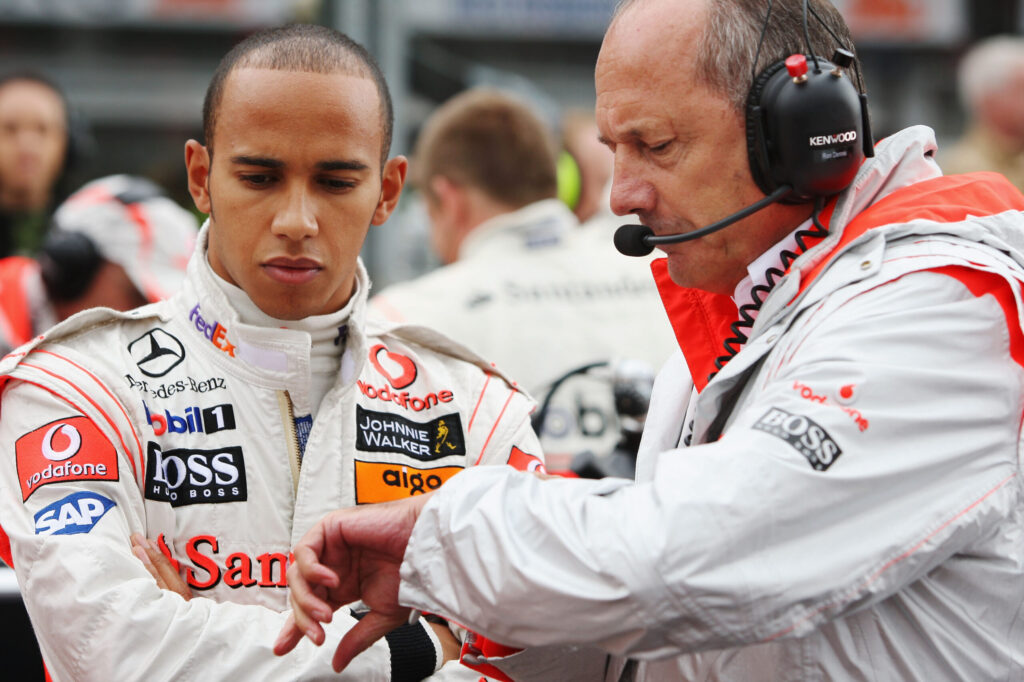
Under Teddy Mayer and later Ron Dennis, McLaren grew over the following decades into one of Formula 1’s pillars. World titles, iconic drivers. Legendary liveries, triumphs — and scandals. It’s all been there. And in a sport that keeps getting louder, faster and more commercial, Bruce McLaren has all along — and still today — stood as a reminder of something essential: that every advance starts with curiosity. Exactly the curiosity he had as a small boy, as a driver and as a young team owner.
Iconic drivers
McLaren can rightly be called a breeding ground for talent and iconic drivers. Emerson Fittipaldi, for example, is the man who won the team’s very first world championship, in 1974. A year later James Hunt was already behind the wheel, the cult hero who went on to become champion in 1976. The team’s greatest run came from the 1980s: Niki Lauda (1984), Alain Prost (1985, 1986, 1989) and Ayrton Senna (1988) stacked up the titles. That same Senna also took the championship for McLaren in 1990 and 1991.
Later that decade Mika Häkkinen did it twice (1998 and 1999). That it then took until Lewis Hamilton (2008) — and even Lando Norris (2025) — to add further titles does nothing to dent McLaren’s legendary status. Along the way the team also claimed ten Constructors’ Championships across its now sixty-year F1 history.
McLaren’s global success began when Ron Dennis took the reins and reshaped the team into a dominant force. Having big names in the cockpit helped. Take Prost, nicknamed ‘The Professor’. Dennis once described him as rational, structured and uncompromising. Sounds familiar? Indeed: Ron Dennis himself.
“At McLaren it always felt like a family,” Prost has said of his time with the team. The Frenchman was deeply involved in decision-making and served as an extension of management. “I tried to support the team and wanted to help in making important decisions. That I was allowed to join Ron Dennis at key meetings was very special.”
However, the rivalry with Senna cast a long shadow over that period. Much has been said about it, including by Prost himself. “Of course we were rivals. For two seasons we drove for the same team, with exactly the same machinery. McLaren deliberately created a competitive situation and the fans loved it.”
Legend
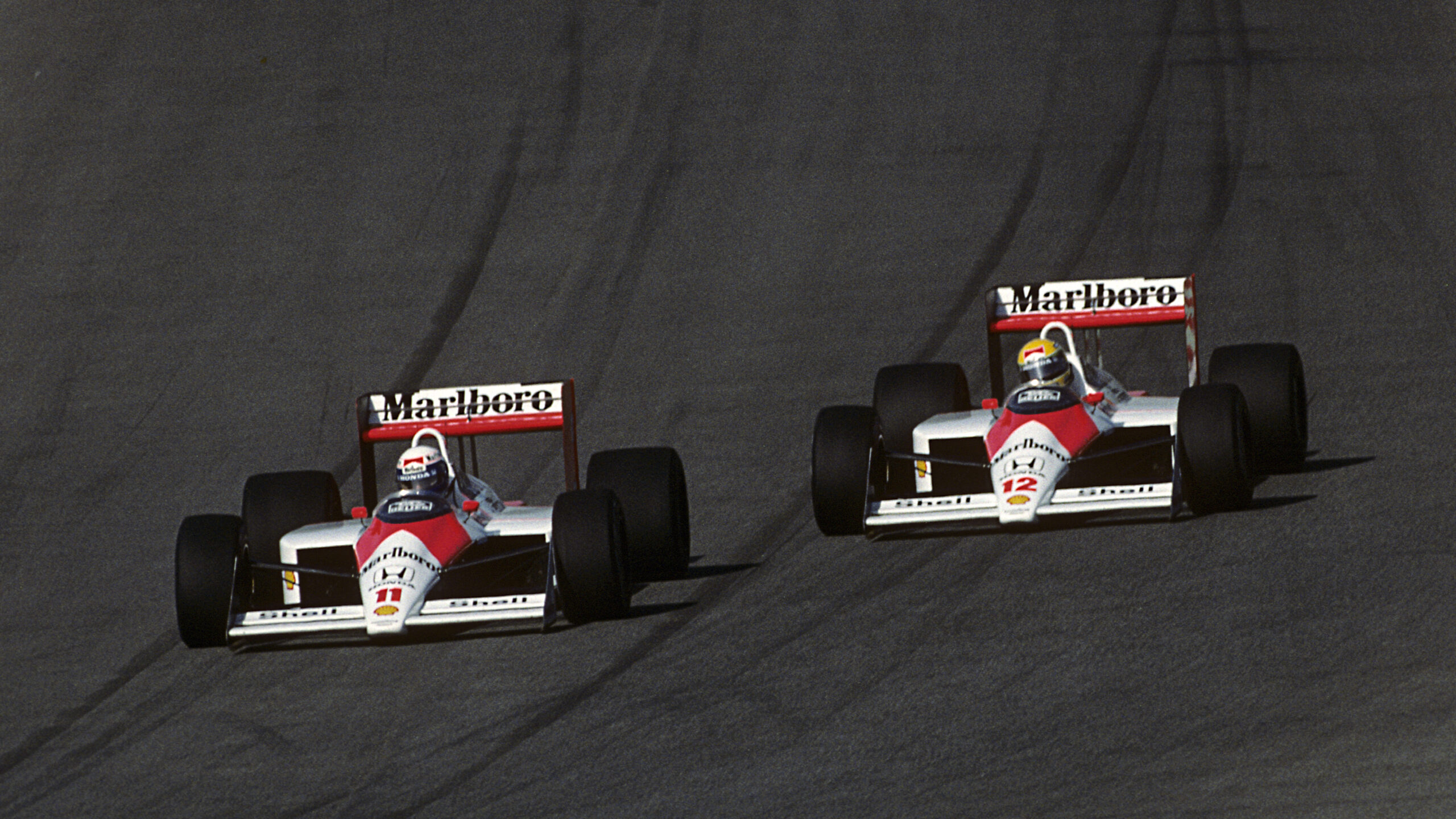
It was Senna himself who gave the team its bite. The pairing of him and the iconic red-and-white Marlboro McLaren is etched into the collective memory of the sport. His performances, his presence and his lines turned Senna into a legend. Just think of that classic one-liner. Loosely translated it goes like this: “If you don’t go for a gap that’s there, you’re no longer a racing driver.”
At McLaren, Senna was given the car, the freedom and the trust to carry that philosophy onto the track. The result: three world championships and an iconic status. “McLaren,” the Brazilian said shortly before his death in the mid‑’90s, “gave me the chance to fight for wins and titles. In the team we pushed to the edge, to the limit. In a positive way.”
His rivalry with teammate Prost, however, also ensured that controversy and internal friction became tied to the McLaren name. The ongoing battle wasn’t only technical but psychological as well. Two extremes of one another — drivers who, as team‑mates, battled each other to the limit (and beyond) in the fight for victories.
That played out, in part, in one of the most successful F1 cars of all time: the McLaren MP4/4 from 1988. Fifteen poles in sixteen races, fifteen wins in those sixteen events. And ten one‑twos for the McLaren drivers. Phenomenal. Further proof of McLaren’s iconic value and status as an F1 team.
Approach
After the Senna‑Prost era McLaren had to reinvent itself, for example with Mika Häkkinen aboard. The Finn was the opposite of those flamboyant predecessors. And yet successful. He, too, became a multiple world champion with the team (1998, 1999).
Häkkinen once described how he felt supported at McLaren in his calm, methodical approach. “They at McLaren always believed in me, even when things were tougher. Preparation and precision — that’s what the team was about. That fitted me and my character perfectly.”
McLaren only found success again ten years later. And what a return. Lewis Hamilton’s rise as a rookie shook the paddock in the best possible way — he instantly won the hearts of fans around the world. In his debut year the Englishman narrowly missed the title; in 2008 he secured it. But a new era of dominance? No, that never materialised. On the contrary: form dipped, Ron Dennis’s influence waned, and McLaren slid further down the order.
Nightmare
The hybrid era proved a nightmare for the famed outfit, until, slowly but surely — and under new owners and leadership — the tide turned. In papaya livery as an homage to founder Bruce McLaren, and under fresh leadership first with CEO Zak Brown and later team principal Andrea Stella, who replaced Andreas Seidl, McLaren over the past years transformed back into the sporting and commercial powerhouse it once was.
The two constructors’ titles in 2024 and 2025 stand as proof. Lando Norris’s championship last autumn does too. And while Max Verstappen unquestionably produced the season’s finest individual performances in 2025, McLaren was the quickest team overall. Norris’s title is well deserved — chapeau. Team-mate Oscar Piastri could easily have been champion as well, which says a lot about how strong McLaren was and still is.
And now? A duel like Prost versus Senna in 2026 and beyond? Who knows. Whether those successes can be repeated and a period of dominance will follow is still an open question given the new regulations coming in for the 2026 season. That McLaren is back at the front, though, is absolutely clear according to the key figures involved.
“It’s an incredible team, on track and in the factory. Everyone is doing an amazing job, we’re winning again and that’s how it should be at McLaren,” Brown said after last season’s success. Team principal Stella puts it down to the team’s culture. “One of constantly wanting to improve.”
And that very trait is precisely what founder Bruce McLaren was known for. Sixty years on, the circle is complete.