
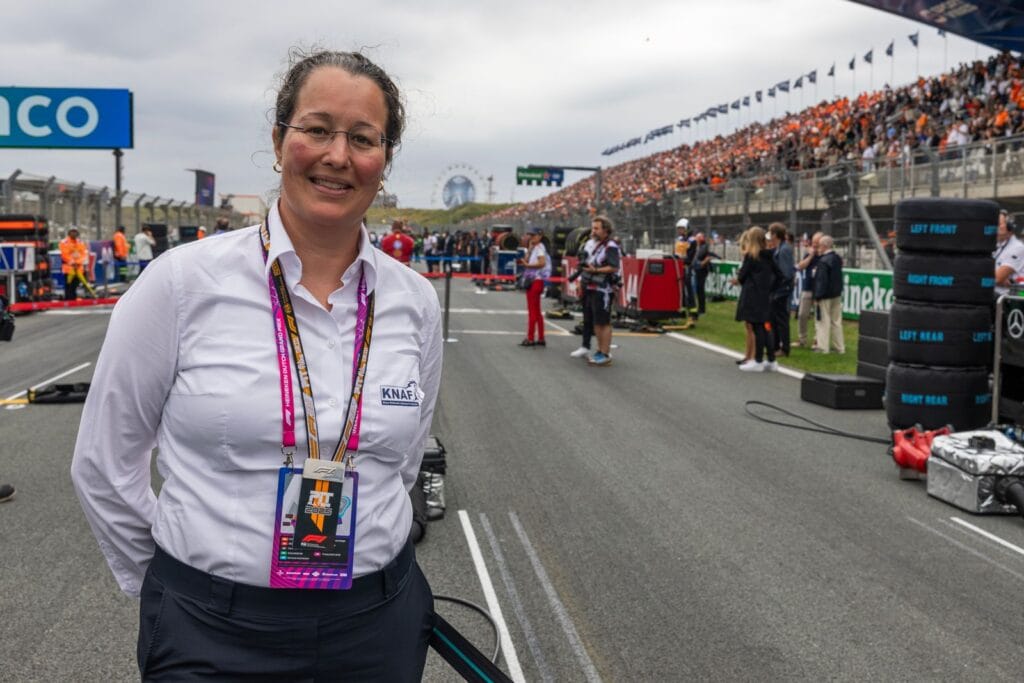
Dutch Natalie Corsmit is making history as the third woman ever to serve as a steward in Formula 1. She opens up about her journey to the pinnacle of motorsport, the criticism she and her colleagues face, and why a fixed pool of stewards isn’t the answer. “You need to maintain a distance.”
Natalie Corsmit caught the racing bug as a child, thanks to her grandfather, the esteemed John Corsmit, who served as both a steward and race director in Formula 1. “I got to go with him to the British GP in the ’80s. It was amazing to see what it takes to organize those cars on the track,” Corsmit recalls.
She was hooked and convinced her parents to let her join her grandfather at a race once a year. Now, over forty years later, she’s stepping into the same role as her grandfather. “I’m incredibly proud. Not just because the FIA recognizes me, but because a dream has come true. As a kid, I stood next to my grandpa and shouted, ‘I want to do this too!’ And he said he would love that.”
With only two female stewards having preceded her in F1, Corsmit remains grounded. “It shouldn’t matter if it’s a man or a woman; you just need to have the same knowledge and skills,” she asserts. “It’s good for diversity in motorsport, and that’s something that’s been worked on in recent years.”
Corsmit believes the low number of female F1 stewards isn’t surprising. “When I signed up with KNAF in 2004, there was only one other woman in a group of 40 stewards. Statistically, it’s harder for women to break through,” she explains. She was warned about entering a male-dominated world but hasn’t felt any negative impact. “Honestly, I’ve never been treated differently by my male colleagues, drivers, or teams.”
On a Voluntary Basis
It’s important to note that stewards work on a voluntary basis, even in the elite world of motorsport where millions are at stake. In her daily life, Corsmit works in education and manages a household with her husband and four children. She’s grateful for the opportunity to pursue her passion in both areas.
Thanks to this support, Natalie Corsmit has climbed the ranks from national to international motorsport. This year, she made her debut in Formula 1, officiating at the GPs of Canada, Belgium, Singapore, and Mexico. You might think the top tier of motorsport would be incredibly stressful, but the reality is quite the opposite. “It’s actually calmer in F1 than in F2 and F3. There, you really have to work hard because there are many more incidents,” Corsmit assures. “Those young drivers are all trying to prove themselves.”
At every F1 race, three stewards team up with a video operator and a driver advisor. This advisor? A former F1 driver who uses their expertise to determine if a driver has crossed the line or if their actions are justifiable on the track.
Understanding the Roles: Stewards vs. Race Control
Confusion often arises about the roles of race control and the stewards, and Corsmit is here to clear it up. “We operate in separate rooms. Only when race control spots something on the track and relays it to the stewards do we spring into action. Think of us as the referees of motorsport,” she explains.
Here’s how it works: as soon as the stewards receive a signal from race control, ‘Noted’ appears on screen. The video operator then pulls up the footage, and the team assesses the incident using TV images, onboard cameras, and circuit cameras.
After reviewing, the stewards have a few options:
- ‘No further investigation’: No penalty is deemed necessary.
- ‘Under investigation’: The stewards will dig deeper and reach a decision.
- ‘Will be investigated after the race’: The stewards want to speak with the drivers post-race about the incident.
“Sometimes we can’t make a call based solely on the footage and need to hear from the drivers’ perspective,” Corsmit elaborates. “When they finish in the top three, they must speak to the press before coming to us. That’s why it can take longer to reach a decision.” Just think back to the incident between Max Verstappen and George Russell in Canada.
Of course, not everyone is happy with the stewards’ decisions, but as Natalie Corsmit points out, that’s part of the sport. “When something happens between two parties, one side is often unhappy while the other is pleased.”
The stewards frequently face criticism in the media and from fans regarding their decisions, but Corsmit maintains a pragmatic view. “The penalties are always well-explained in the decisions we publish. I just wonder if people actually read them. Opinions are often formed based on what they see on TV, but that doesn’t always provide the full picture,” Corsmit states. “So, read our publications, and you’ll see the differences between the penalties.”
Critics in the Spotlight: Are They Missing the Mark?
Critics of the racing regulations, according to Corsmit, often lack the full picture. “They frequently compare incidents and penalties to previous years, unaware that the rules have changed,” she reveals. “Rules evolve based on specific events and exceptions. We don’t make these changes ourselves; it’s always a discussion between the FIA, teams, and drivers.”
Corsmit has developed a thick skin and knows how to brush off criticism. “You learn that at the national level in this role. The KNAF trains us for it,” she explains. A bit of self-protection helps deflect negativity. “I avoid social media for the first few days after a Grand Prix and steer clear of clickbait sites.”
Changing Stewards: A Smart Move?
There’s been talk of establishing a permanent pool of stewards, but Corsmit isn’t convinced. “It’s crucial for a steward to remain independent and not get too familiar with teams and drivers. You need to maintain a distance,” she insists. “That’s why a rotating pool is beneficial. It prevents a driver from claiming, ‘This steward has it in for me all year.’”
Corsmit hopes to shift the perception some have of stewards. “We’re just people volunteering because we love the sport. The sport needs us to function, as everyone in elite sports pushes the limits. We must ensure they don’t cross the line. And if they do, we don’t make decisions lightly,” she clarifies. “We genuinely think it through, weighing everything with the information available at that moment.”
From National Karting to F1 Stardom
Natalie Corsmit kicked off her journey in 2004 by obtaining her Dutch steward license, competing in various classes. She made waves as a national steward during the Dutch GP weekend in 2021, which led to her opportunity as an international steward at Imola. Meanwhile, she attended seminars to earn her international FIA license.
In 2023, Corsmit was selected alongside seven other stewards for the FIA’s new High Performance Program, prepping them for top-tier classes like Formula 1, where they also train during a Grand Prix. After successfully completing this program in 2024, Corsmit was set for her F1 debut. Beyond international formula classes, she remains active in local series, from autocross to the National Karting Championship.