

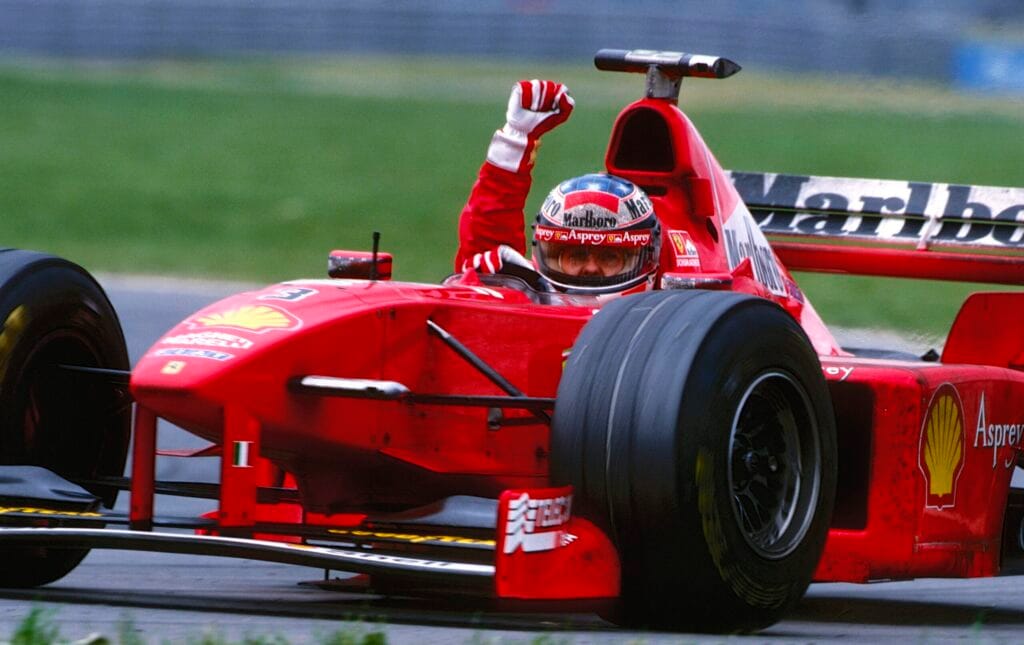
Thirty years ago, Michael Schumacher’s arrival helped transform a struggling Ferrari into a dominant force in Formula 1. Those involved share their insights on how the German breathed new life into the Italian powerhouse between 1996 and 2006.
Today, Luca Colajanni is based in the modern headquarters of tyre supplier Pirelli in the Formula 1 paddock. A quarter of a century ago, during Schumacher’s era, the Italian was the Director of Communications at Ferrari. “This,” he says, pointing to his phone, “we didn’t have back then.” The PR boss of Formula 1’s tyre partner is referring to social media and its influence. “Michael would have hated it if he were still a driver today.”
He shakes his head. Then, Colajanni pulls out a photo. “This one is special to me,” he says. The close bond and connection between the two at that time is clearly visible. “That’s why I share this photo once a year, of Michael and me, together during our time at Ferrari.”
Although the now 57-year-old ‘Schumi’ may have long since left Formula 1, he remains a legend and the seven-time world champion will never be forgotten. This is evident when you speak to people like Colajanni in the current paddock about the German, his influence on the sport, and especially on Ferrari. And yes, like every legend, there are people who have more and less affinity with him than others.
Since his tragic skiing accident in 2013, Schumacher has lived in anonymity and no one knows – or tells – exactly how he is doing. On the one hand, this increases the sympathy for him. On the other hand, it adds to the mystique that, according to those involved, has always somewhat surrounded his person and especially his private life. “But a good person, with a heart of gold; that’s what he has always been,” says Colajanni.
‘Very special to experience’
Colajanni is not the only one who speaks warmly of Schumacher. Andrea Stella and Mattia Binotto, for example, have also done so more than once. The team boss of McLaren and the CEO of Sauber, respectively, who are also involved in the Audi F1 project, know all too well what it’s like to work with Schumacher. They were there at the time, just like Colajanni. Like so many others who still roam the paddock. They saw up close the influence the German had on the famous racing team. “And how he, as a driver and as a person, brought about a revival and success. It was very special to experience.”
Colajanni would know. He worked at Ferrari before the turn of the century and became the head of the communications department in 2000. He spoke with ‘Schumi’ even more than Stella and Binotto did. The trio can certainly tell how Schumacher single-handedly transformed Ferrari at the end of the 90s and the beginning of this century. Or breathed new life into it, as Colajanni puts it.
Michael Schumacher celebrated in Hungary 2001 (Peter van Egmond)
According to Colajanni, two words characterize Schumacher: “Leadership and commitment.” These were already resonating in Maranello when the German started to make his mark on the ‘Scuderia’ from his arrival in 1996. “During the years I worked with him, I saw how he committed himself to making the team successful. His level of dedication was unparalleled,” Colajanni recounts.
For Binotto, who was then responsible for the engine department as an engineer, Schumacher was no ordinary driver. He has repeatedly stated this in various media, underscoring the strength of the message: “Michael brought something special to Ferrari, not only in terms of on-track performance but also in work ethic and mentality. He made us work not just harder, but above all, smarter.”
‘Infectious Determination’
Stella, who later became head of the racing department, worked closely with Schumacher. He uses similar words to describe the German. The current team boss of McLaren calls the seven-time world champion a born leader during his time at Ferrari: “His determination was infectious. He inspired everyone to consistently bring out the best in themselves.”
Schumacher’s influence thus extended beyond that of many other drivers. The German ensured that progress was made in all areas within Ferrari, including outside the car. Schumacher was heavily involved in the development of the car. “Michael had a keen eye for detail,” Stella previously admitted in the Beyond the Grid podcast. “Michael’s ability to translate his feedback into practical improvements was exceptionally large.”
Binotto also confirms the German’s involvement: “It was Michael’s way of thinking, his drive to win… These are examples of a mentality and an attitude with which he single-handedly managed to elevate the entire team to a higher level at that time.”
Since his move to Ferrari, where he raced from 1996 to 2006, Schumacher introduced unique methods, celebrating five of his seven championships and becoming a figurehead with a distinct approach, more focused on teamwork than many outsiders realized. This ranged from daily briefings with mechanics and feedback sessions after each run to full involvement in tuning the car; practices that are now standard within a Formula 1 team.
‘It all started with him’
Binotto: “Many of the habits we see as a given in our sport started in the Schumacher years.” Stella confirmed this in a conversation with Autosport. “His influence is felt in the DNA of Formula 1. How we plan, how we analyze, how we work – it all started with him.”
But there’s more: Schumacher, as a person, brought out the best in Ferrari employees. Speed and improvement, result and success; it was all not only in the technical or sporting approach of the team, but also in the human aspect.
Colajanni recalls, for example, how different Schumacher was than his public image suggested. “Many people thought he was a cold or ‘cold’ German. But within the team, he was very approachable and a warm person. Especially with Jean Todt (team boss at the time), he built a beautiful relationship in which they always protected each other.”
What if Schumacher had raced in this era? “I think he would not feel at home in the world of social media and continuous cameras,” suggests Colajanni. “Michael had an aura of focus and privacy. He would never have become a driver who entertains people with filters or crazy videos.”
Schumacher would probably have been too sober for that. This trait also kept the passionate Italians grounded. According to them, the German driver knew exactly how and when to direct people and had a natural authority. “Michael could enter a room and without saying anything you felt his presence,” says Colajanni. “I call that charisma.”
Protective and loyal
The balance between business and empathy made Schumacher unique. He could be strict when necessary, but also protective and loyal. Colajanni: “I remember a moment when I disagreed with Jean Todt. Michael helped me convince Jean. He said: ‘Jean, he says this because it helps us. Let him try’.”
More Than Professional Support
“Sabine Kehm, his spokesperson, also became my colleague and friend. Michael fostered harmony — something that is rare in the hustle and bustle of Formula 1,” says Colajanni.
The bond between Schumacher and Ferrari was more than just sporting. Binotto recalls the German’s humility after winning titles. “He would always come to us, thank the mechanics, the engineers. He understood that Formula 1 is a team sport.” Stella once referred to it in motorsport as a ‘total package’: speed, insight, humility. “He changed the way the team functioned. He set the bar so high that everyone automatically followed that rhythm.”
‘The Man Who Made Ferrari Win Again’
And the Italians, the Ferrari fans? According to Colajanni, they saw it too. They will forever be grateful to Schumacher for the way he brought renewed success to the most famous Formula 1 team in the world in the late 90s and early 2000s. “If I ask people on the street in Italy what they think of Schumacher, they say: ‘That’s the man who made Ferrari win again’.”
Since his accident in 2013, there has been little news about Schumacher’s condition. “His accident and its aftermath; it’s still so sad,” says Colajanni. “But I have great respect for his family’s decision to protect his privacy.” The fact that Schumacher still has such a prominent presence out of the spotlight speaks volumes about his legend. “His name comes up in the paddock every day. He remains an example,” says Colajanni. “Even young engineers who never worked with him speak of him with respect. Inside and outside Ferrari, Michael is an eternal phenomenon.”
About Colajanni, Binotto, and Stella
Luca Colajanni was already working at Ferrari before 2000, but in that year he became head of communications for the Formula 1 team. In this role, he was responsible for press relations, media contacts, and managing Ferrari’s public image during the team’s most successful period. He worked closely with Sabine Kehm, Schumacher’s spokesperson, and had a direct line to the German. Colajanni played a key role in coordinating communication between the team, driver, and media.
Mattia Binotto joined Ferrari in 1995, just before Schumacher’s arrival. He worked in the engine department as an engineer, where he was involved in the development and optimization of the V10 engines that made Ferrari’s dominance in the early 2000s possible.
Andrea Stella began at Ferrari at the beginning of this century as a performance engineer. He worked directly with Schumacher as a race engineer and was responsible for analyzing data, tuning the car, and translating Schumacher’s feedback into technical improvements. Stella was known for his analytical ability and his ability to convert Schumacher’s technical input into concrete adjustments.
Schumi & Ferrari in Numbers:
Period: 1996-2006
World titles: 5 (2000-2004)
Number of races: 180
First places: 72
Second places: 43
Third places: 19
Retirements: 31
Pole positions: 58